Binder Content, Grain Size, and Performance: What Every Engineer Should Know
In tungsten carbide engineering, performance is never accidental—it is engineered at the microstructural level. Among the most critical variables are binder content and grain size in tungsten carbide, which together dictate the balance between hardness, toughness, wear resistance, and overall component life. For engineers designing cutting tools, wear components, or high-load mechanical systems, understanding how these parameters interact is essential to achieving optimal results.
At Ultra-Met, decades of powder metallurgy expertise—from RTP formulation through CNC pressing and advanced sintering—enable precise control over these variables, ensuring carbide solutions are tailored to application-specific demands.
The Fundamentals of Tungsten Carbide Structure
Tungsten carbide (WC) composites are typically composed of:
- Tungsten Carbide (WC grains) — provides wear resistance and hardness
- Metallic binder phase (commonly cobalt or nickel) — provides toughness and crack resistance
During powder blending, pressing, and sintering, these constituents form a dense, interpenetrating structure. The final properties depend heavily on:
- WC grain size
- Binder percentage and distribution
- Sintering conditions and sintering method (e.g., HIP vs vacuum sintering)
Binder Content: The Toughness Lever
How Binder Affects Performance
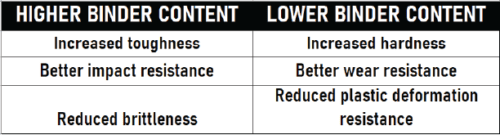
The binder phase acts as a ductile matrix that absorbs energy and resists crack propagation. Adjusting binder content changes performance characteristics in predictable ways:
Engineering Trade-Offs
- High binder grades (10–20%)
Ideal for:- Mining tools
- Oil & gas drilling components
- Applications with impact and shock loading
- Low binder grades (3–8%)
Ideal for:- Precision cutting tools
- High-speed machining
- Abrasive wear environments
The key is balance—too much binder sacrifices hardness, while too little risks catastrophic fracture.
Grain Size: The Hardness Driver
Grain Size Classification
Carbide grain sizes are typically categorized as:
- Ultrafine (<0.6 µm)
- Submicron (0.6–1 µm)
- Fine (0.1-1.5 µm)
- Medium (1.5–3.5 µm)
- Coarse (>3.5 µm)
Impact on Properties
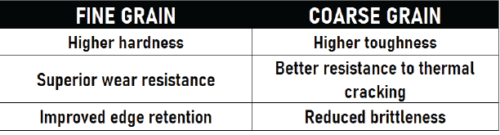
Fine grains increase grain boundary density, which restricts movement between the grains of WC—resulting in higher hardness and abrasion resistance.
The Critical Interaction: Binder × Grain Size
Binder content and grain size cannot be optimized independently. Their interaction defines the material’s performance envelope.
Key Relationships
- Fine grain + low binder
- Maximum hardness
- Best for high-speed cutting and finishing
- Fine grain + higher binder
- Balanced toughness and wear
- Ideal for general-purpose tooling
- Coarse grain + high binder
- Maximum toughness
- Best for heavy-duty, impact environments
- Coarse grain + low binder(rarely used)
- Poor structural integrity
- Generally avoided in engineering applications
The Role of Processing in Achieving Target Properties
Precise control over binder distribution and grain growth depends heavily on manufacturing processes:
Powder Preparation
Uniform blending of tungsten carbide with binder metals and additives ensures consistent microstructure before pressing.
Compaction (CNC Pressing)
Controlled pressure forms a “green compact” with uniform density, critical for avoiding defects during sintering.
Sintering and Densification
- Vacuum sintering minimizes contamination and oxidation
- HIP sintering increases density and eliminates porosity, along with the benefits of vacuum sintering.
These processes directly influence:
- Grain growth behavior
- Binder phase distribution
- Final density and mechanical strength
Application-Driven Material Selection
Engineers should align binder and grain size selection with real-world operating conditions:
Cutting Tools (Metalworking)
- Fine or submicron grain
- Low-to-moderate binder
- Goal: edge retention, wear resistance
Oil & Gas / Mining
- Medium-to-coarse grain
- Higher binder
- Goal: impact resistance and toughness
Wear Parts
- Balanced grain size and binder
- Goal: extend service life under abrasion
Ultra-Met’s ability to produce components across a broad range of densities and hardness values enables precise tuning for each application.
Common Design Pitfalls
Even experienced engineers can encounter performance issues when these variables are misaligned:
- Excessively fine grain in high-impact applications → brittle failure
- Too much binder in abrasive environments → accelerated wear
- Improper sintering control → porosity and reduced strength
These failures are rarely random—they are typically microstructural mismatches. If your carbide fails, it also tells the tale of why. Reading and understanding the failed carbide can help adjust binder content and/or grain size to get the performance needed.
Final Takeaway: Engineering at the Micro Level
Binder content and grain size are not just material specifications—they are the primary levers of carbide performance. Mastering their interaction allows engineers to:
- Extend tool life
- Reduce downtime
- Optimize cost-performance ratios
- Improve reliability in extreme environments
With advanced powder metallurgy capabilities, precision pressing, and controlled sintering, manufacturers like Ultra-Met ensure these variables are not left to chance—but engineered with purpose.