CNC Pressing for Compaction: Precision at the Core of Carbide Manufacturing
In the world of advanced manufacturing, precision and consistency are everything—especially when working with materials as demanding as carbide. One of the most critical steps in producing high-performance carbide components is CNC pressing for compaction. This process transforms loose powder into durable, precisely shaped “green” parts that are ready for final strengthening through sintering.
At Ultra-Met Carbide Technologies, CNC pressing is not just a step in production—it’s a cornerstone of quality, enabling the creation of complex, high-performance components used across demanding industries.
Advanced CNC Pressing Capabilities
Modern manufacturing requires flexibility, power, and accuracy. That’s why Ultra-Met utilizes some of the most advanced CNC presses available today, capable of producing a wide variety of shapes with intricate geometries.
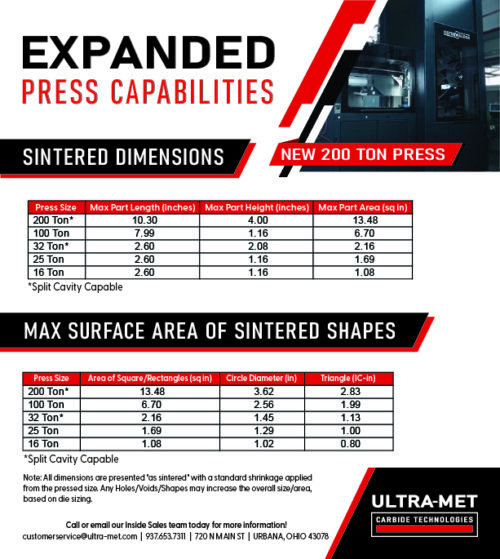
The company’s press lineup ranges from 16-ton presses for smaller, detailed parts to a state-of-the-art 200-ton press designed for larger and more demanding components. This high-capacity press allows for the formation of parts exceeding several inches in length and up to four inches in height—opening the door to more robust and complex applications.
For even larger carbide components, Ultra-Met employs ISO pressing technology, which enables the production of parts over 14 inches in length. This capability ensures that even the most demanding industrial requirements can be met with precision and reliability.
From Powder to Part: The Compaction Process
The journey from raw material to finished carbide component begins with powder preparation. A carefully engineered blend of materials—typically including:
- Tungsten carbide
- Cobalt or nickel binders
- Lubricants and additives
is created to achieve the desired mechanical and physical properties.
Once blended, the powder is placed into a precisely machined die. This is where CNC pressing comes into play.
Applying Pressure with Precision
During the compaction stage, the CNC press applies controlled, high pressure from both the top and bottom of the die. This dual-action pressing ensures:
- Even density throughout the part
- Accurate replication of die geometry
- Minimal internal defects
The result is a solidified part that maintains its shape once removed from the die. This part is now in the “green state”, similar to a piece of sidewalk chalk.
Understanding the Green State
After compaction, the part enters what is referred to as the green state. At this stage:
- The component has its final intended shape
- It is strong enough to be handled and even lightly machined
- However, the metal particles are not yet fully bonded
While the green compact is stable, it has not yet reached its full mechanical strength or density. That transformation occurs in the next critical step: sintering.
Why CNC Pressing Matters
CNC pressing offers several key advantages that make it essential in carbide manufacturing:
1.Precision and Repeatability
Computer-controlled presses ensure every part is produced with consistent dimensions and density, reducing variability and improving quality.
2. Complex Geometry Capability
Intricate shapes and tight tolerances can be achieved directly during pressing, minimizing the need for costly post-processing.
3. Efficient Production
High-speed, automated pressing allows for scalable production without sacrificing accuracy.
4. Material Optimization
Even powder distribution and controlled compaction reduce waste and improve the final material performance.
Setting the Stage for Sintering
While compaction defines the shape, sintering defines the strength. The quality of the green compact directly impacts the success of the sintering process. Uniform density and proper pressing ensure:
- Optimal bonding of particles
- Maximum hardness and wear resistance
- Structural integrity
In other words, a well-pressed part is the foundation of a high-performing finished product.
Final Thoughts
CNC pressing for compaction is far more than a preliminary step—it is a highly engineered process that determines the quality, performance, and reliability of carbide components. With advanced equipment ranging from 16-ton to 200-ton presses, along with ISO pressing capabilities for large parts, Ultra-Met Carbide Technologies delivers precision at every stage.
From carefully blended powders to expertly compacted green parts, every detail matters. And in industries where durability and accuracy are non-negotiable, CNC pressing ensures that every component starts strong—ready to reach its full potential through sintering and beyond.